Smartphone Charging Standards: A Complete Guide to Fast Charging Technologies
Smartphone charging has evolved dramatically over the past decade. Gone are the days when charging a phone from 0% to 100% took several hours. Modern smartphones now support fast charging technologies capable of delivering a full day’s power in less than 30 minutes. However, with different charging standards such as USB Power Delivery, Qualcomm Quick Charge, PPS, VOOC, SuperVOOC, HyperCharge, and MagSafe, choosing the right charger can be confusing.
Table of Contents
- What Are Smartphone Charging Standards?
- Understanding Charging Power
- USB Charging Evolution
- USB Power Delivery (USB PD)
- Programmable Power Supply (PPS)
- Qualcomm Quick Charge
- Samsung Super Fast Charging
- Apple’s Charging Standard
- MagSafe Charging
- Qi Wireless Charging
- Oppo SuperVOOC
- OnePlus SUPERVOOC
- Xiaomi HyperCharge
- vivo FlashCharge
- HONOR SuperCharge
- Motorola TurboPower
- Realme SUPERVOOC
- Proprietary vs Universal Charging Standards
- Why Charger Compatibility Matters
- Battery Safety Features
- Tips to Maximize Battery Life
- Which Charging Standard is Best?
- Final Thoughts
What Are Smartphone Charging Standards?
A charging standard is a set of technical specifications that determines how electricity is delivered from a charger to a smartphone. It defines factors such as:
- Voltage
- Current
- Power output (Watts)
- Communication between charger and device
- Safety mechanisms
- Compatibility
Modern charging standards intelligently adjust power delivery based on the device’s battery level and temperature, ensuring both speed and safety.
Understanding Charging Power
Charging speed is measured in watts (W). The basic formula is:
Power (Watts) = Voltage × Current Examples:
- 5V × 2A = 10W
- 9V × 2A = 18W
- 11V × 6A = 66W
- 20V × 5A = 100W
Higher wattage generally means faster charging, provided both the charger and smartphone support the same charging standard.
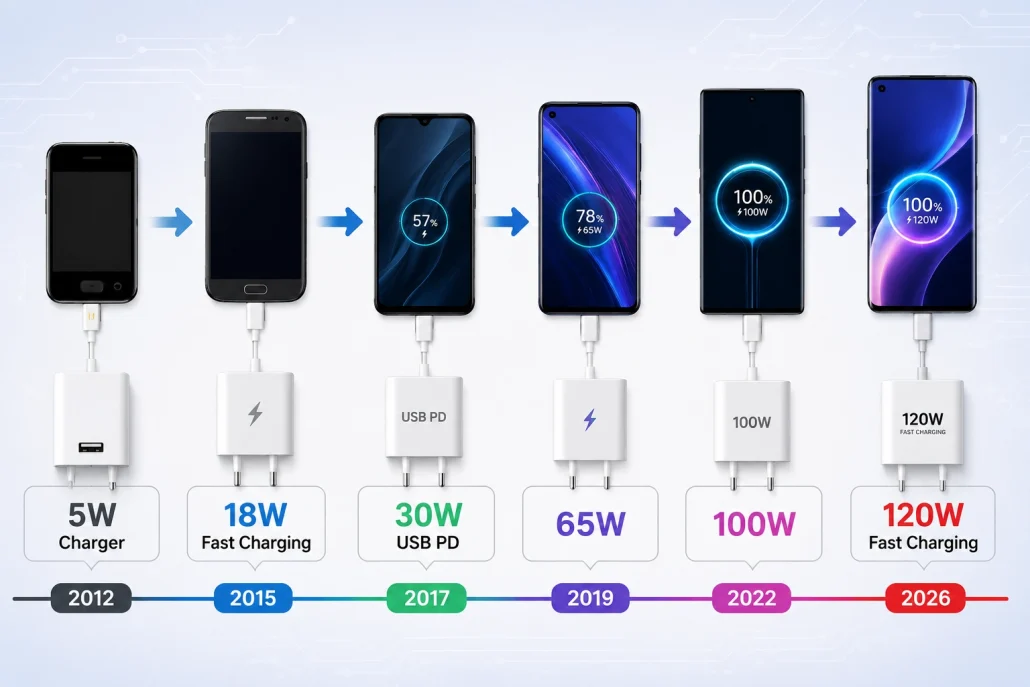
The evolution of smartphone charging standards, highlighting the transition from 5W charging to modern 120W fast charging technologies between 2012 and 2026.
USB Charging Evolution
USB-A
USB-A was the standard connector for many years. Typical charging speeds:
- 5W
- 10W
- 12W
Although still found on older chargers, USB-A is gradually being replaced by USB-C.
USB-C
USB-C has become the universal charging connector for modern smartphones. Advantages include:
- Reversible connector
- Faster charging
- Faster data transfer
- Support for USB Power Delivery
- Better compatibility across devices
Today, nearly all Android smartphones and even newer iPhones use USB-C.
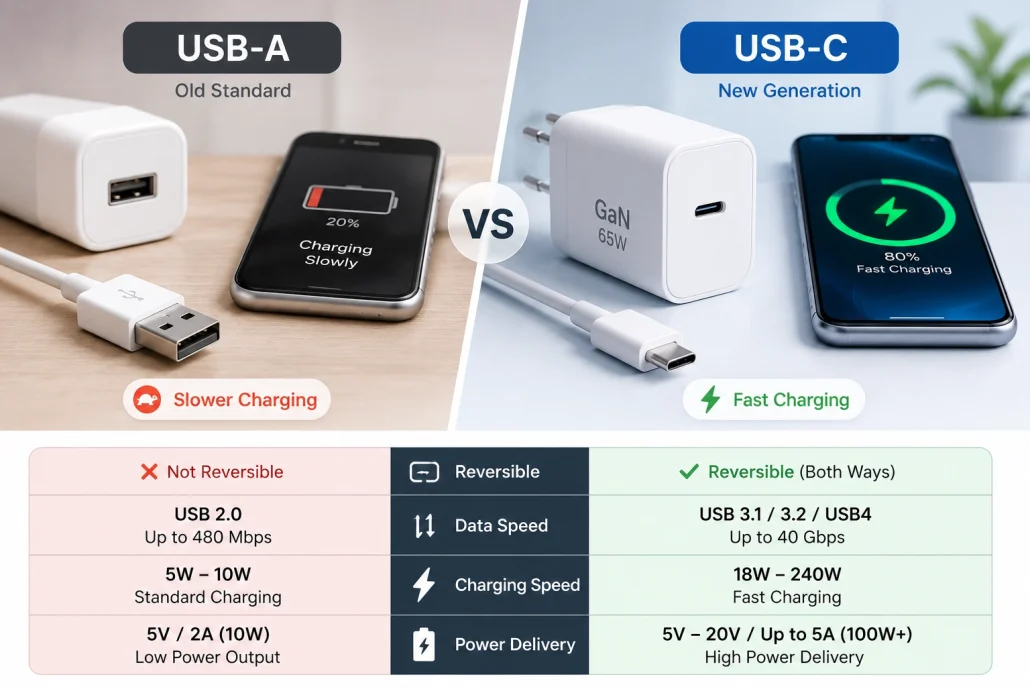
Side-by-side comparison of USB-A and USB-C connectors showing an older USB-A charger and a modern USB-C GaN charger, highlighting differences in reversibility, data transfer speed, charging speed, and USB Power Delivery support.
USB Power Delivery (USB PD)
USB Power Delivery, commonly called USB PD, is the industry’s universal fast charging standard developed by the USB Implementers Forum. It supports intelligent communication between the charger and the connected device.
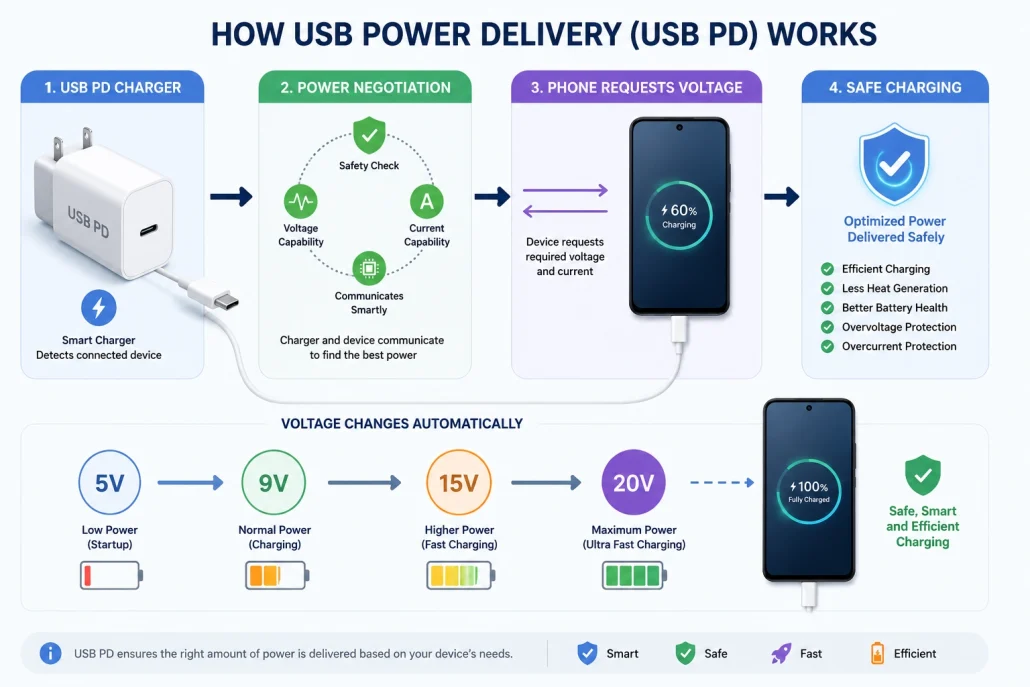
Flow diagram illustrating how USB Power Delivery (USB PD) works, showing a USB PD charger, power negotiation, phone voltage requests, automatic voltage switching between 5V, 9V, 15V, and 20V, and safe charging.
Common power levels include:
- 18W
- 20W
- 30W
- 45W
- 65W
- 100W
- 140W and beyond (with newer USB PD revisions)
Advantages
- Universal compatibility
- Safe power negotiation
- Charges smartphones, tablets, laptops, and accessories
- Supported by Apple, Google, Samsung, Motorola, Nothing, and many others
USB PD is widely considered the future of universal charging.
Programmable Power Supply (PPS)
Programmable Power Supply (PPS) is an advanced feature within USB Power Delivery. Instead of fixed voltage levels, PPS continuously adjusts voltage and current according to the phone’s needs. Benefits include:
- Reduced heat generation
- Higher charging efficiency
- Better battery longevity
- Faster charging
Samsung’s Super Fast Charging 2.0 relies heavily on PPS.
Qualcomm Quick Charge
Qualcomm Quick Charge is one of the earliest fast charging technologies for Android smartphones powered by Snapdragon processors. Popular versions include:
- Quick Charge 3.0
- Quick Charge 4+
- Quick Charge 5
Features:
- Intelligent voltage adjustment
- Backward compatibility
- Improved thermal management
- USB PD compatibility in newer versions
Although less dominant than before, Quick Charge remains common on many Android devices.
Samsung Super Fast Charging
Samsung combines USB Power Delivery with PPS to deliver its Super Fast Charging technology. Common charging speeds include:
- 25W
- 45W
Advantages:
- Excellent battery protection
- Wide charger compatibility
- Efficient temperature management
Using a charger without PPS may reduce charging speed on Samsung devices.
Apple’s Charging Standard
Apple now uses USB-C across the iPhone lineup. Modern iPhones support:
- USB Power Delivery
- Approximately 20W–30W wired charging depending on the model
- Qi wireless charging
- MagSafe wireless charging
Apple recommends certified USB PD chargers for optimal performance.
MagSafe Charging
MagSafe is Apple’s magnetic wireless charging system. Key benefits:
- Magnetic alignment
- Stable wireless charging
- Better efficiency than traditional Qi charging
- Compatible accessories
MagSafe chargers automatically align with supported iPhones for improved charging performance.
Qi Wireless Charging
Qi (pronounced “chee”) is the global wireless charging standard developed by the Wireless Power Consortium. Most flagship smartphones support Qi.
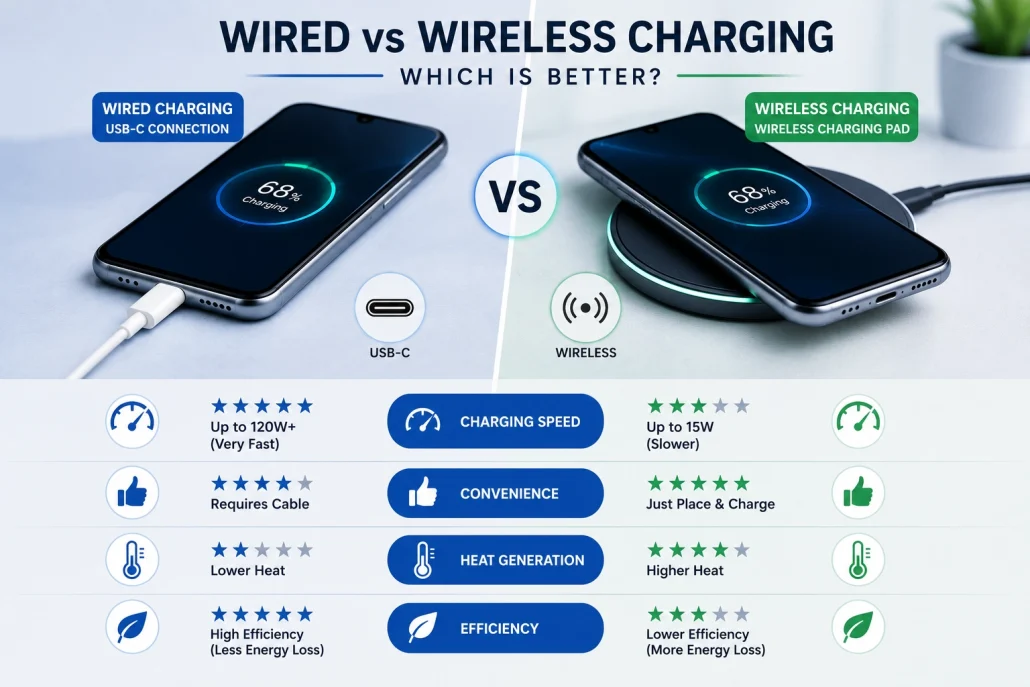
A side-by-side comparison of wired USB-C charging and wireless charging, illustrating the key differences in speed, convenience, heat generation, and energy efficiency.
Advantages include:
- Cable-free charging
- Universal compatibility
- Safe operation
- Convenient for desks and bedside tables
Wireless charging is slower than wired charging but continues to improve with newer Qi2 technology.
Oppo SuperVOOC
Oppo SuperVOOC technology focuses on extremely fast charging. Current implementations range from:
- 67W
- 80W
- 100W
Some earlier models even supported higher proprietary speeds. Features include:
- Low battery heat
- Dual-cell battery architecture
- Intelligent power management
- Special charging cable requirements
OnePlus SUPERVOOC
OnePlus now shares Oppo’s charging technology under the SUPERVOOC branding. Typical charging speeds:
- 80W
- 100W
Benefits include:
- Very rapid charging
- Battery protection
- Efficient heat management
Using the official charger and cable ensures maximum charging speed.
Xiaomi HyperCharge
Xiaomi’s HyperCharge technology offers some of the fastest charging speeds in the smartphone industry. Supported speeds vary by model:
- 67W
- 90W
- 120W
Advantages:
- Extremely short charging times
- Smart thermal monitoring
- Multiple safety protections
Maximum speeds usually require Xiaomi-certified chargers and cables.
vivo FlashCharge
vivo uses FlashCharge technology for many of its smartphones. Charging speeds include:
- 44W
- 66W
- 80W
- 120W
The system employs advanced battery monitoring to maintain safe temperatures during high-speed charging.
HONOR SuperCharge
HONOR smartphones support SuperCharge technology, offering:
- 66W
- 100W
Many newer HONOR devices also support USB Power Delivery, improving compatibility with third-party chargers.
Motorola TurboPower
Motorola’s TurboPower technology is largely based on USB Power Delivery and Qualcomm Quick Charge. Typical speeds include:
- 30W
- 68W
- 125W (select models)
Its advantage lies in broad compatibility with standard USB PD chargers.
Realme SUPERVOOC
Realme uses SUPERVOOC charging technology inherited from the BBK Electronics ecosystem. Supported charging speeds include:
- 45W
- 67W
- 80W
- 120W
These chargers often require proprietary cables for maximum performance.
Proprietary vs Universal Charging Standards
Not all fast charging systems are equally compatible.
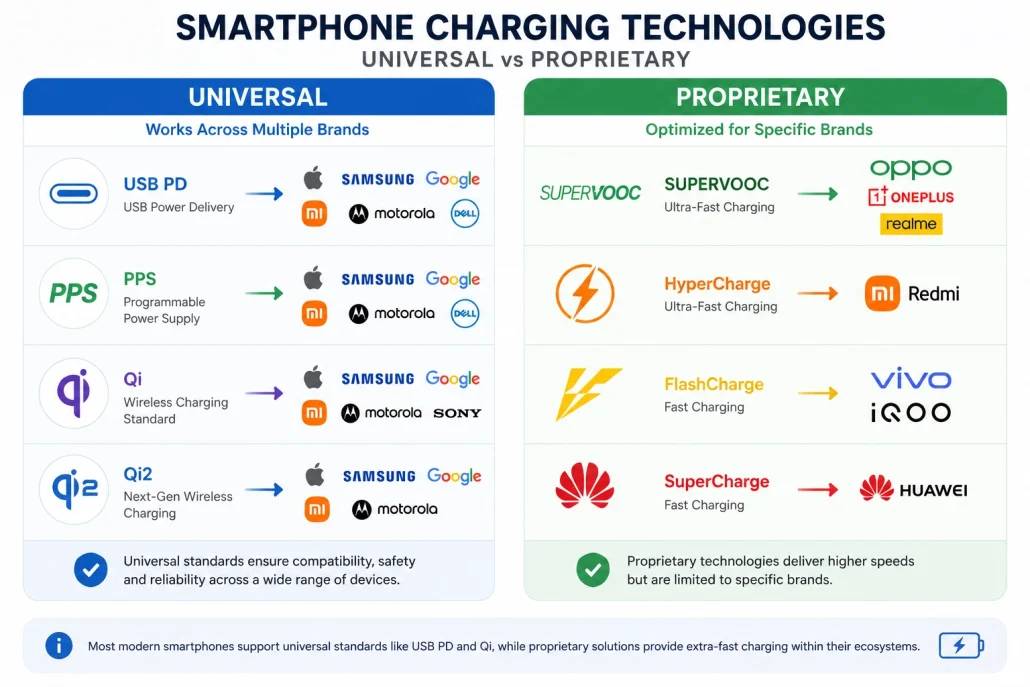
A visual comparison of universal charging standards that work across multiple brands and proprietary fast charging technologies designed for specific smartphone ecosystems.
Universal Standards
- USB Power Delivery
- PPS
- Qi
- Qi2
Advantages:
- Work across multiple brands
- Easier to replace chargers
- Better long-term compatibility
Proprietary Standards
- SUPERVOOC
- HyperCharge
- FlashCharge
- SuperCharge
- TurboPower (partially)
Advantages:
- Often faster
- Optimized for specific devices
Disadvantages:
- May require original charger and cable
- Reduced speed with third-party chargers
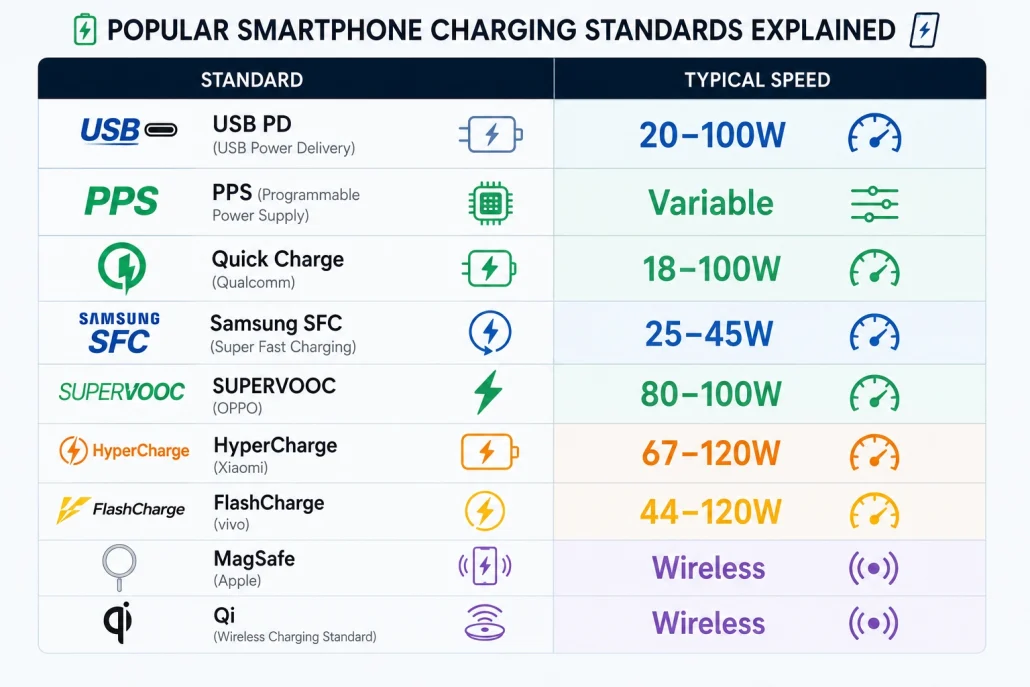
A comparison of the most widely used smartphone charging standards and their typical wired and wireless charging speeds.
Why Charger Compatibility Matters
Buying a high-wattage charger does not automatically guarantee faster charging. https://www.youtube.com/watch?v=o18b2LSq7Ow For example:
- A 100W charger may only deliver 20W if the phone does not support higher power.
- A Samsung phone charges fastest with a PPS-enabled USB PD charger.
- A OnePlus phone reaches peak charging speeds only with its compatible SUPERVOOC charger and cable.
Always check your smartphone’s supported charging protocols before purchasing a charger.
Battery Safety Features
Modern charging standards include multiple safety mechanisms:
- Temperature monitoring
- Over-voltage protection
- Over-current protection
- Short-circuit protection
- Battery health optimization
- Intelligent power regulation
These technologies help maintain battery lifespan despite faster charging speeds.
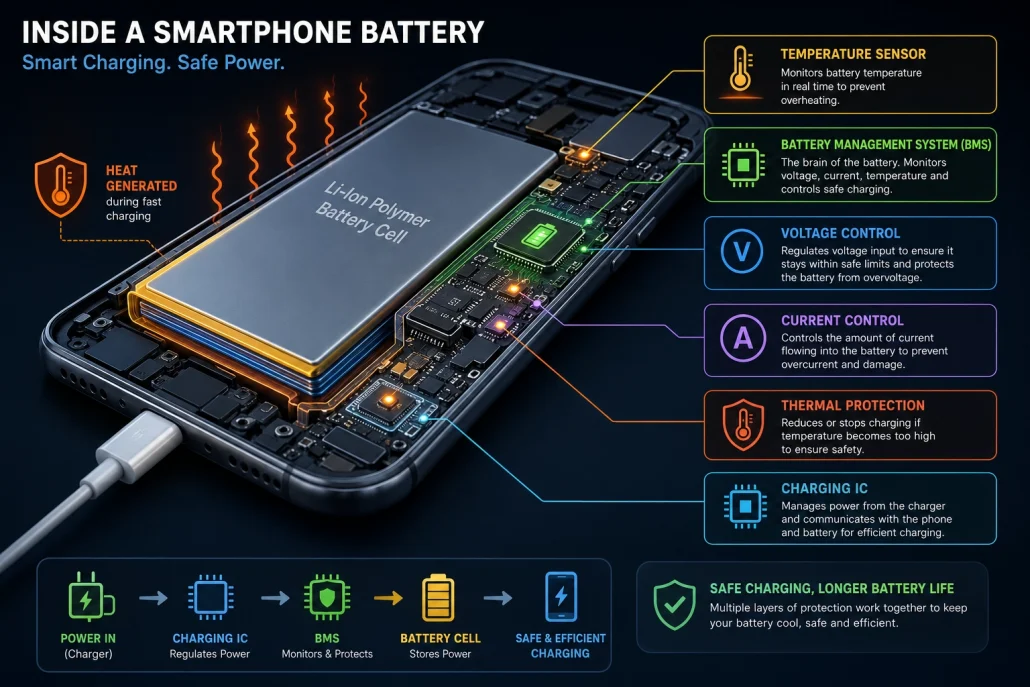
A cross-sectional view of a smartphone battery highlighting the key components that monitor temperature, regulate power, and protect the battery during fast charging.
Tips to Maximize Battery Life
Follow these practices to keep your battery healthy:
- Use certified chargers and cables.
- Avoid extremely cheap, uncertified accessories.
- Keep your phone cool while charging.
- Remove thick cases if excessive heat builds up.
- Update your phone regularly for charging optimizations.
- Enable adaptive or optimized charging features if available.
- Avoid keeping the battery at 100% for extended periods whenever possible.
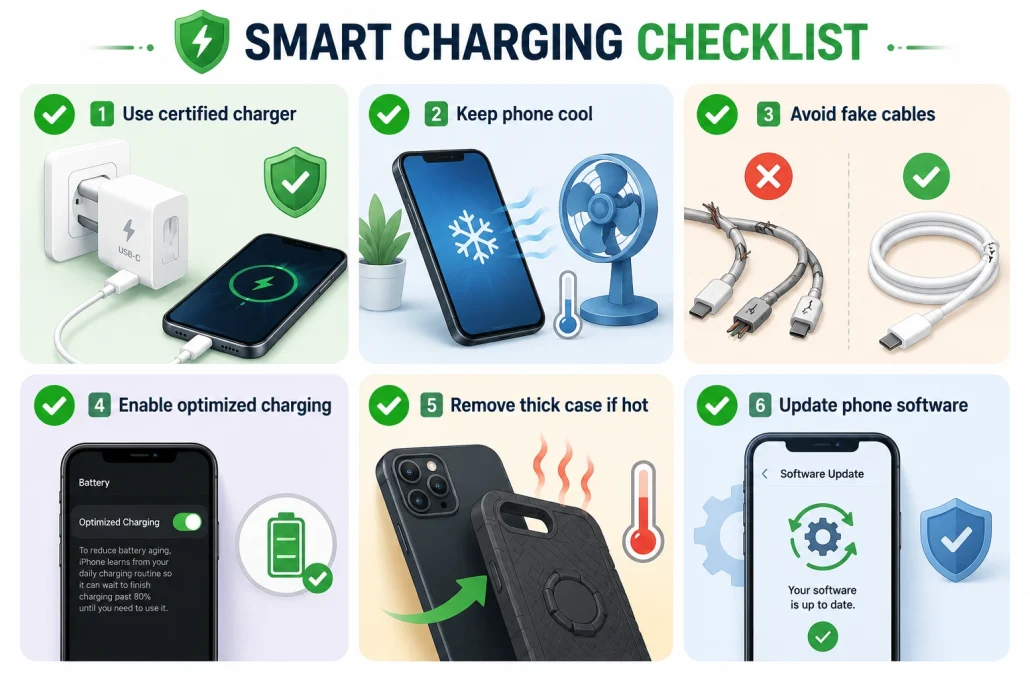
An illustrated checklist highlighting essential smartphone charging best practices.
Which Charging Standard is Best?
For most users, USB Power Delivery with PPS offers the best balance of speed, compatibility, and future-proofing. It works across smartphones, tablets, laptops, and many accessories, making it an excellent long-term investment. If you own a phone from brands like OnePlus, Oppo, Xiaomi, vivo, or Realme, using the manufacturer’s official charger often provides the fastest charging experience due to proprietary technologies. However, for travelers or users with multiple devices, a high-quality USB PD charger with PPS support offers greater convenience and broad compatibility.
Final Thoughts
Smartphone charging standards have become more advanced, delivering faster speeds while improving battery safety and efficiency. Whether you’re using USB Power Delivery, Qualcomm Quick Charge, Samsung Super Fast Charging, Apple’s MagSafe, or proprietary systems like SUPERVOOC and HyperCharge, understanding your phone’s supported charging protocol helps you get the best performance.
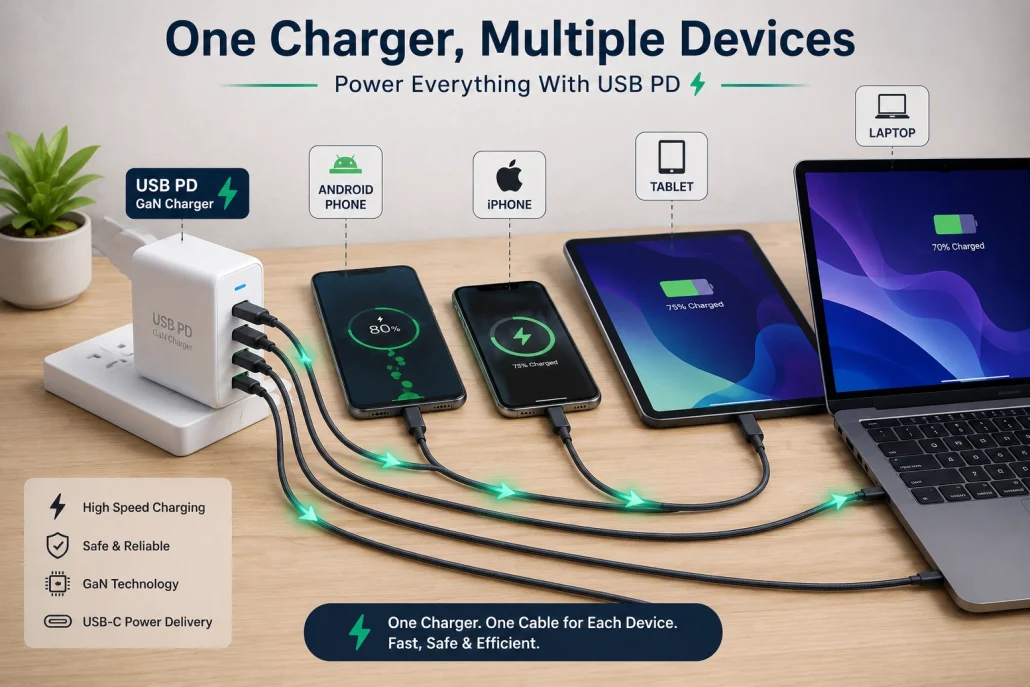
A USB Power Delivery (USB PD) GaN charger can safely and efficiently power multiple USB-C devices, including smartphones, tablets, and laptops.
As USB-C and USB Power Delivery continue to gain widespread adoption, the future of smartphone charging is becoming more universal, reducing cable clutter and making it easier to power multiple devices with a single charger.