The Evolution of Operating Systems: From Early Mainframes to Modern Cloud Computing
Operating Systems have undergone a remarkable transformation over the past several decades. From managing massive room-sized mainframe computers to powering billions of smartphones, IoT devices, and cloud-based servers, operating systems have become the backbone of modern computing. Understanding the evolution of operating systems provides valuable insight into how technology has advanced and why today’s digital infrastructure is more efficient, secure, and scalable than ever before.
Table of Contents
- What is an Operating System?
- The Early Days: Operating Systems for Mainframe Computers (1950s–1960s)
- The Rise of Multiprogramming (1960s–1970s)
- Time-Sharing Systems Revolutionize Computing
- UNIX Changes Everything
- The Personal Computer Era (1980s)
- Graphical User Interfaces Transform User Experience
- The Internet Era and Network Operating Systems
- Linux and the Open-Source Revolution
- Mobile Operating Systems Redefine Computing
- Virtualization Changes Data Centers
- The Cloud Computing Era
- Artificial Intelligence and Modern Operating Systems
- Security Becomes a Core Priority
- The Future of Operating Systems
- Conclusion
What is an Operating System?
An operating system (OS) is system software that manages computer hardware and software resources while providing essential services for applications. It acts as the bridge between users, applications, and the underlying hardware.
Core functions of an operating system include:
- Managing CPU and memory resources
- Handling file systems
- Controlling input and output devices
- Managing processes and multitasking
- Providing security and user authentication
- Offering user interfaces for interaction
Without an operating system, computers would require users to communicate directly with hardware, making them extremely difficult to operate.
The Early Days: Operating Systems for Mainframe Computers (1950s–1960s)
The earliest computers had no operating systems. Programs were loaded manually using punch cards or paper tape, and each task had to be completed before another could begin.

Vintage computer room featuring large mainframe cabinets, magnetic tape drives, punch cards, and engineers operating early computing systems during the early evolution of operating systems.
As computing demand increased, early operating systems were introduced to automate repetitive tasks and improve hardware utilization. Key characteristics included:
- Batch processing
- Single-user operation
- Minimal memory management
- Manual job scheduling
Batch operating systems grouped multiple jobs together and processed them sequentially, significantly reducing idle time for expensive mainframe systems. Although primitive by today’s standards, these early operating systems laid the foundation for future innovations.
The Rise of Multiprogramming (1960s–1970s)
As computer hardware became more powerful, developers introduced multiprogramming. Instead of waiting for one program to finish before loading another, multiple programs could remain in memory simultaneously. This innovation dramatically improved processor utilization by allowing the CPU to switch between tasks whenever one program was waiting for input or output operations. Benefits included:
- Better CPU efficiency
- Reduced idle time
- Faster job completion
- Improved resource sharing
Multiprogramming represented one of the first major breakthroughs in operating system design.
Time-Sharing Systems Revolutionize Computing
Time-sharing systems emerged during the late 1960s and transformed computers into multi-user platforms. Instead of dedicating an entire computer to one user, operating systems rapidly switched processor time among multiple users, creating the illusion that everyone had their own machine. Advantages included:
- Multiple simultaneous users
- Interactive computing
- Improved productivity
- Remote terminal access
Universities and research institutions widely adopted time-sharing systems because they maximized the value of costly computer hardware.
UNIX Changes Everything
One of the most influential milestones in the history of operating systems came with the introduction of UNIX in the early 1970s.

Modern graphical user interface displaying multiple application windows, desktop icons, file manager, and multitasking features on a computer monitor with keyboard and mouse.
UNIX introduced concepts that remain essential today, including:
- Portable operating system design
- Multi-user support
- Multitasking
- Hierarchical file systems
- Modular architecture
- Powerful command-line interface
Its flexibility and reliability made UNIX popular across universities, businesses, and government organizations. Many modern operating systems-including Linux, macOS, Android, and several enterprise server platforms-trace their roots back to UNIX principles.
The Personal Computer Era (1980s)
The arrival of affordable personal computers fundamentally changed operating system development. Instead of serving large organizations, operating systems now targeted individual users. Popular systems during this era included:
- MS-DOS
- Apple System Software
- IBM PC operating environments
These operating systems focused on simplicity, affordability, and compatibility with rapidly growing software libraries. Although early PC operating systems lacked advanced multitasking capabilities, they introduced millions of people to personal computing.
Graphical User Interfaces Transform User Experience
The introduction of graphical user interfaces (GUIs) marked another major turning point. Rather than memorizing command-line instructions, users could interact using:

Modern graphical user interface displaying multiple application windows, desktop icons, file manager, and multitasking features on a computer monitor with keyboard and mouse.
- Windows
- Icons
- Menus
- Pointer devices (mouse)
Graphical operating systems made computers significantly easier to learn and use. This innovation fueled widespread adoption in homes, schools, and businesses, making computing accessible to non-technical users. Today, graphical interfaces remain the standard for desktops, laptops, tablets, and smartphones.
The Internet Era and Network Operating Systems
The rapid expansion of the internet during the 1990s dramatically expanded the responsibilities of operating systems. Modern operating systems now had to support:
- Internet connectivity
- Networking protocols
- Remote access
- Web applications
- Security against online threats
Networking features became built-in rather than optional. This period also saw the rise of enterprise server operating systems designed to support websites, email servers, databases, and corporate networks. Reliability, scalability, and security became top priorities.
Linux and the Open-Source Revolution
The emergence of Linux in the early 1990s transformed the technology industry. Unlike proprietary operating systems, Linux embraced open-source development, allowing developers worldwide to improve the software collaboratively.
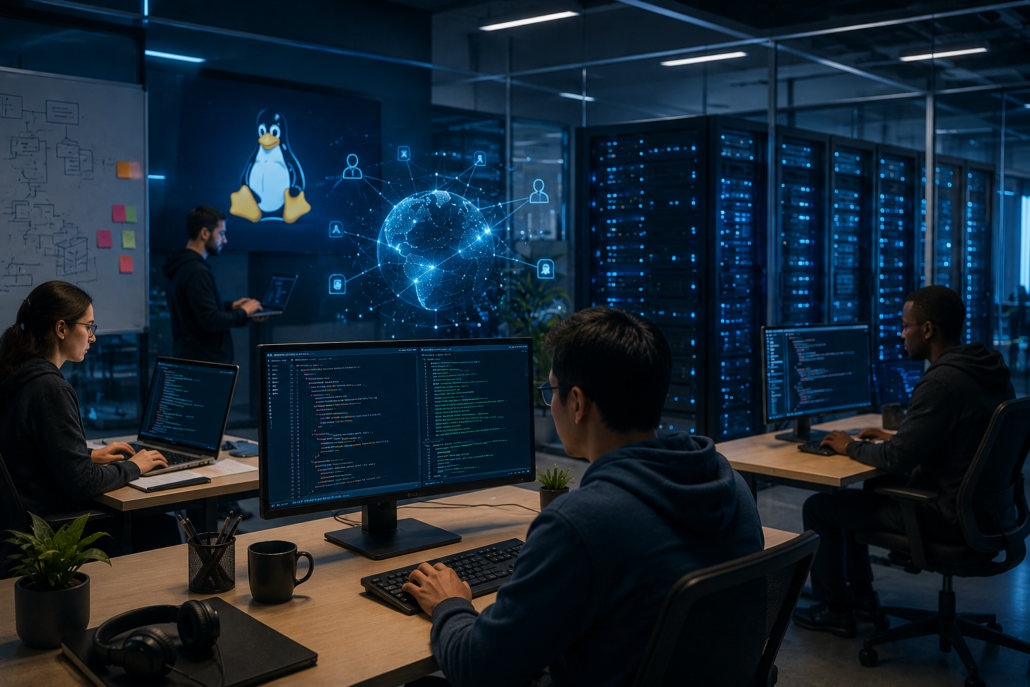
Developers collaborating in a modern server room with terminal windows, interconnected servers, and Linux-powered open source infrastructure supporting enterprise computing.
Benefits of Linux include:
- Free distribution
- Strong security
- Excellent stability
- High customization
- Broad hardware compatibility
Today, Linux powers:
- Most web servers
- Supercomputers
- Cloud infrastructure
- Android smartphones
- Embedded systems
- IoT devices
Its influence on modern computing cannot be overstated.
Mobile Operating Systems Redefine Computing
The smartphone revolution introduced entirely new requirements for operating systems. Mobile operating systems needed to optimize:

Collection of smartphones, tablets, and wearable devices displaying modern mobile operating system interfaces with cloud synchronization and wireless connectivity.
- Battery life
- Touchscreen interaction
- Wireless communication
- Application ecosystems
- Location services
- Sensor integration
Modern mobile platforms support millions of applications while efficiently managing limited battery and hardware resources. They also introduced advanced security features such as biometric authentication, application sandboxing and encrypted storage.
Virtualization Changes Data Centers
As businesses required greater computing efficiency, virtualization became increasingly important. Virtualization allows multiple virtual machines to run on a single physical server. Operating systems evolved to support:
- Hypervisors
- Virtual machines
- Dynamic resource allocation
- Live migration
- Hardware abstraction
This technology significantly reduced infrastructure costs while improving scalability and reliability. Virtualization became the foundation for modern cloud computing.
The Cloud Computing Era
Cloud computing represents the latest major evolution in operating systems. Rather than relying solely on local hardware, modern applications often run across distributed cloud infrastructure consisting of thousands of interconnected servers.

Modern cloud data center featuring virtual servers, containerized infrastructure, distributed networks, and digital cloud connections representing scalable cloud computing and virtualization.
Cloud-focused operating systems emphasize:
- Scalability
- High availability
- Automation
- Resource orchestration
- Container management
- Distributed computing
Instead of managing individual servers manually, organizations can automatically deploy applications across entire data centers. Cloud-native operating systems work seamlessly with technologies like containers, Kubernetes, serverless computing, and edge computing to deliver reliable services worldwide.
Artificial Intelligence and Modern Operating Systems
Artificial intelligence is becoming an integral component of modern operating systems. Today’s operating systems increasingly use AI for:

Futuristic illustration of an AI-powered operating system managing cloud computing, edge devices, IoT networks, autonomous systems, quantum computing, and holographic digital interfaces.
- Intelligent resource management
- Predictive maintenance
- Security threat detection
- Performance optimization
- Voice assistants
- Automated updates
Machine learning algorithms help systems adapt to user behavior while improving efficiency and reducing manual administration. As AI hardware accelerators become more common, operating systems continue evolving to leverage these capabilities effectively.
Security Becomes a Core Priority
Cybersecurity has evolved from an optional feature into a central responsibility of operating systems. Modern operating systems incorporate multiple layers of protection, including:
- Secure boot
- Disk encryption
- Multi-factor authentication
- Application isolation
- Memory protection
- Continuous security updates
With ransomware, phishing, and sophisticated cyberattacks becoming more common, operating systems must constantly evolve to defend users and organizations.
The Future of Operating Systems
The next generation of operating systems will focus on intelligence, automation, and seamless connectivity. Emerging trends include:
- AI-driven system optimization
- Edge computing integration
- Quantum computing support
- Enhanced cloud-native architecture
- Stronger privacy protections
- Autonomous infrastructure management
Future operating systems may require minimal user intervention, automatically optimizing performance, security, and energy consumption while adapting to changing workloads. As cloud services, IoT devices, and artificial intelligence continue to expand, operating systems will become even more critical to global digital infrastructure.
Conclusion
The evolution of operating systems reflects the broader history of computing itself. From simple batch-processing software on early mainframes to sophisticated cloud-native platforms managing millions of virtual machines, operating systems have continuously adapted to meet changing technological demands.
Today’s operating systems not only manage hardware but also enable artificial intelligence, cloud computing, cybersecurity, virtualization, and mobile ecosystems. As technology advances toward intelligent automation, edge computing, and quantum processing, operating systems will remain at the center of innovation. Understanding this journey helps businesses, developers, IT professionals, and technology enthusiasts appreciate how operating systems continue to shape the digital world and prepare us for the next generation of computing.