Tempered Glass vs Plastic Screen Protectors: Which is Better?
Your smartphone’s display is one of its most important and expensive components to repair. A screen protector adds an extra layer of protection against scratches, everyday wear, and certain types of impact. However, choosing the right option can be confusing because tempered glass and plastic screen protectors offer different benefits.
Table of Contents
- What is a Tempered Glass Screen Protector?
- What is a Plastic Screen Protector?
- Tempered Glass vs Plastic Screen Protectors: Key Differences
- Tempered Glass vs Plastic Screen Protectors: Comparison Table
- Which Screen Protector is Better for Your Phone?
- Tips for Choosing the Right Screen Protector
- Final Verdict: Tempered Glass or Plastic?
- Frequently Asked Questions
When comparing tempered glass vs plastic screen protectors, the main differences include scratch resistance, impact protection, touch sensitivity, clarity, thickness, installation, and price. Tempered glass is popular for its glass-like feel and strong scratch resistance, while plastic protectors are valued for their flexibility, thin construction, and affordability.
The best choice depends on how you use your smartphone, whether you prefer a natural screen feel, and how much protection you need. Understanding these differences will help you choose a screen protector that suits your device and daily routine.
What is a Tempered Glass Screen Protector?
A tempered glass screen protector is made from specially processed glass designed to provide a protective layer over a smartphone display. The glass undergoes a strengthening process that improves its resistance to everyday scratches and certain impacts.

A transparent tempered glass screen protector is aligned above a smartphone display, showing its rigid construction and polished edges.
Most tempered glass protectors have an adhesive layer that attaches them to the display. Many also feature an oleophobic coating to reduce fingerprints and make the surface easier to clean.
Tempered glass is available in different thicknesses and designs, including edge-to-edge coverage, privacy glass, and protectors with specialized coatings. Some models are designed to work with fingerprint sensors and curved displays, although compatibility varies.
The biggest advantage of tempered glass is its familiar glass-like feel. It generally offers excellent clarity, smooth scrolling, and better resistance to scratches from everyday contact with keys, coins, and other objects.
However, tempered glass can crack or chip when subjected to a sufficiently strong impact. Although it may sacrifice itself to help protect the underlying display, it cannot guarantee that your phone’s screen will remain undamaged after a drop.
What is a Plastic Screen Protector?
A plastic screen protector is a thin, flexible film applied directly to a smartphone display. The most common types are PET (polyethylene terephthalate) and TPU (thermoplastic polyurethane).
PET protectors are typically thin, lightweight, and affordable. They offer basic protection against scratches and surface marks but provide limited cushioning against significant impacts.

A thin transparent plastic screen protector is gently curved beside a smartphone to demonstrate its flexibility and lightweight construction.
TPU protectors are more flexible and elastic than PET films. They can conform to curved displays and may absorb minor impacts more effectively than rigid plastic films. Some TPU products also feature self-healing properties that allow certain shallow surface marks to become less noticeable over time.
Plastic screen protectors are generally thinner than tempered glass and may be less noticeable during use. However, their surface can feel less smooth, and some models attract fingerprints or develop visible scratches more quickly.
These films are suitable for users who prioritize minimal thickness, flexible coverage, or an inexpensive way to protect their phone’s display from everyday wear.
Tempered Glass vs Plastic Screen Protectors: Key Differences
Understanding the main differences makes it easier to decide which type offers the best value for your smartphone.
Scratch Resistance
Tempered glass generally provides better scratch resistance than standard PET and TPU films. Its hard surface helps prevent everyday contact with common objects from leaving marks on the protector.

A tempered glass screen protector and a plastic screen protector sit side by side, illustrating differences in surface scratches and finish.
Plastic films can scratch more easily, particularly when exposed to abrasive materials. TPU may hide or recover from some minor surface marks, but this does not mean every scratch disappears.
For users who want to keep their display looking clear and smooth, tempered glass is usually the better option.
Drop and Impact Protection
Tempered glass can help protect a smartphone display by absorbing some impact energy and potentially cracking before the original screen does. However, the outcome depends on the force, angle, impact surface, phone design, and protector quality.

A smartphone in a protective case rests beside a chipped tempered glass screen protector, illustrating the role of screen protection in everyday use.
Plastic protectors are flexible and can resist cracking, but ordinary films provide limited protection against hard impacts. TPU may offer some cushioning, although it should not be considered a replacement for a protective phone case.
Neither material guarantees protection against a broken display. A quality case with raised edges can complement either protector by helping reduce direct contact between the screen and surrounding surfaces during a fall.
Clarity and Display Quality
Both tempered glass and plastic protectors can provide good display clarity when properly manufactured and installed.
Tempered glass usually delivers a more natural viewing experience because its surface closely resembles the original smartphone screen. It can preserve sharpness, brightness, and color reproduction while minimizing noticeable surface distortion.

A fingertip interacts with a smartphone display through a clear screen protector, demonstrating visibility and touchscreen usability.
Plastic films may also be clear, but lower-quality options can introduce haze, reflections, or a slightly uneven appearance. Matte plastic films intentionally reduce glare, though they may make the display look grainier.
For users who watch videos, read extensively, or play mobile games, a high-quality tempered glass protector is generally the more comfortable choice.
Touch Sensitivity and Fingerprint Recognition
Tempered glass typically offers a smooth surface that supports natural swiping, typing, and gaming. However, excessively thick or poorly fitted glass can affect touch responsiveness on some devices.
Plastic protectors are thin and often maintain good touch sensitivity. Their flexibility can also make them suitable for curved screens that are difficult to cover with rigid glass.
Fingerprint recognition depends on the phone’s sensor technology and the protector’s design. Some under-display fingerprint sensors work better with specific glass protectors, while others may require a compatible film or an adjustment to touch sensitivity settings.
Always check device compatibility before purchasing a protector, particularly if your smartphone has a curved display or an ultrasonic fingerprint sensor.
Thickness, Flexibility, and Installation
Tempered glass is rigid and usually easier to apply without wrinkles, provided the display is clean and the protector is correctly aligned. However, trapped dust can create bubbles, and poorly designed models may lift around curved edges.
Plastic films are thinner and more flexible, making them suitable for displays with curved edges. Nevertheless, installation can be more challenging because the film may develop wrinkles, stretch marks, or air bubbles.
If you prefer a firm, glass-like surface and straightforward installation, tempered glass is usually the more convenient option. If you want minimal added thickness or flexible coverage, plastic may be more appropriate.
Price and Long-Term Value
Plastic screen protectors are often less expensive than tempered glass, especially basic PET films. They can be a practical choice for budget-conscious users who primarily want protection from scratches.
Tempered glass generally costs more, but it often provides a better balance of scratch resistance, clarity, and everyday usability. Its long-term value depends on how frequently it needs replacing and how well it performs in your daily routine.
Premium glass protectors can also be expensive, so paying more does not automatically guarantee better protection. Look for reliable fit, coating quality, and verified compatibility rather than choosing based on price alone.
Tempered Glass vs Plastic Screen Protectors: Comparison Table
| Feature | Tempered Glass | Plastic Screen Protector |
|---|---|---|
| Scratch resistance | Generally excellent | Basic to moderate |
| Impact protection | Can help absorb some impacts | Limited; TPU may cushion minor impacts |
| Screen clarity | Usually excellent | Good to excellent, depending on quality |
| Surface feel | Smooth and glass-like | Can feel softer or less smooth |
| Flexibility | Rigid | Flexible |
| Thickness | Usually thicker | Usually thinner |
| Installation | Often straightforward | Can be challenging |
| Curved-screen compatibility | Depends on design | Often suitable for curved displays |
| Price | Low to premium | Usually inexpensive |
| Best use | Everyday protection and natural touch feel | Thin coverage and basic scratch protection |
Which Screen Protector is Better for Your Phone?
The right screen protector depends on your priorities and how you use your smartphone.
Choose tempered glass if:
- You want strong resistance to everyday scratches.
- You prefer a smooth, glass-like surface.
- You regularly use your phone for gaming, video streaming, and browsing.
- You want a practical balance of clarity, durability, and convenience.
Choose a plastic screen protector if:
- You want a thin and lightweight protective layer.
- You prefer a flexible film for a curved display.
- You mainly want to prevent scratches and surface marks.
- You want an inexpensive protector that is easy to replace.
For most smartphone users, tempered glass is the better all-round choice. However, a compatible plastic film can be more suitable for certain curved displays or for people who prioritize flexibility and minimal thickness.
Tips for Choosing the Right Screen Protector
Before buying a screen protector, check your phone’s exact model number. Protectors made for similar-looking devices may have different cutouts, dimensions, or edge designs.

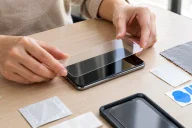
A person carefully aligns a transparent screen protector over a smartphone display using a clean workspace and installation accessories.
Consider these additional factors:
- Check case compatibility: Choose a protector that does not lift when used with your phone case.
- Look for an oleophobic coating: This can help reduce fingerprints and make cleaning easier.
- Verify fingerprint support: Confirm that the protector is compatible with your device’s fingerprint sensor.
- Consider your environment: Outdoor users may prefer scratch-resistant glass, while users with curved displays may benefit from flexible film.
- Buy from a reliable seller: Clear specifications, a proper installation kit, and a suitable replacement policy can improve the overall experience.
Remember that hardness ratings and marketing claims do not tell the whole story. Real-world performance depends on material quality, construction, installation, and compatibility.
Final Verdict: Tempered Glass or Plastic?
When comparing tempered glass vs plastic screen protectors, tempered glass is generally the better option for users who want excellent scratch resistance, clear visuals, and a smooth touchscreen experience. Plastic protectors remain useful for affordable, lightweight, and flexible coverage.
Neither option makes a smartphone completely damage-proof. For more comprehensive everyday protection, combine a suitable screen protector with a well-fitted phone case and avoid exposing the display to abrasive materials.
Ultimately, the best screen protector is one that fits your phone correctly, supports its features, and matches your everyday needs. For most people, tempered glass offers the strongest overall combination of usability and practical protection, while plastic remains a sensible alternative when flexibility and low cost matter most.
Frequently Asked Questions
Is tempered glass better than plastic screen protectors?
Yes, tempered glass is generally better for scratch resistance, surface smoothness, and a natural viewing experience. Plastic films are thinner, more flexible, and usually cheaper.
Can a plastic screen protector prevent a cracked screen?
A plastic film provides some surface protection, but ordinary PET films offer limited impact protection. TPU may provide additional cushioning against minor impacts, but neither material guarantees that the display will survive a drop.
Does tempered glass affect touchscreen sensitivity?
A properly fitted, compatible tempered glass protector usually maintains normal touchscreen responsiveness. Poor-quality or incompatible protectors can interfere with touch input or fingerprint recognition.
How often should I replace my screen protector?
Replace a protector when it becomes cracked, chipped, heavily scratched, loose, or difficult to see through. A damaged tempered glass protector should be replaced promptly, even if the phone’s original display appears intact.
Which screen protector is best for curved displays?
Flexible TPU films are often suitable for curved displays because they can conform to the screen’s shape. Specially designed tempered glass protectors can also work, provided they are compatible with the device and its case.